
How to Groom a Dog With Matted Hair
Working through a matted coat without causing pain requires the right tools, the right technique, and an honest assessment of what can safely be done at home.
First: Understand What You Are Dealing With
Mats are not just tangled fur. A mat is a dense, compressed knot of dead and live hair that has wrapped around itself over time. Surface mats, the ones you can see and feel on top of the coat, are usually the easiest to deal with. The ones that cause the most problems are the ones that form close to the skin, invisible until you press through the top layer and feel the solid mass underneath.
Before you start, run a metal comb from the skin outward through several areas of the coat. If the comb moves freely to the skin, you are dealing with surface tangles that most owners can manage at home. If it catches, pulls, or stops completely before reaching the skin, the mat is too deep to brush out safely without causing pain. That is the dividing line between a home brushing job and a professional de-matting or clip-out.
What You Need Before Starting
Attempting to work through mats with the wrong tools causes pain and makes the dog worse at future appointments. These are the tools that actually help:
Tools That Work for Matted Coats
- Metal comb (wide and narrow tooth)Assessment + finishing
- Slicker brush (firm pins)Surface mat removal
- Dematting comb or rakeWorking through tangles
- Detangling spray or conditioning sprayReduces friction
- Blunt-tip scissors (for separating, not cutting through)Splitting large mats
How to Work Through a Surface Mat
The method matters as much as the tools. Brushing directly through a mat from above pulls the skin and causes pain even when the mat is relatively loose. Work from the outside edges inward instead.
- Hold the base of the mat. Place your hand between the mat and the skin before you brush. This prevents the pulling force from reaching the skin. It is the single most important thing you can do to make the process less painful.
- Apply detangling spray. A light coating of conditioning or detangling spray reduces friction between the hairs and makes the mat easier to separate without tearing.
- Work the edges first. Use the dematting comb or slicker brush to loosen the outer edges of the mat before working toward the center. Small strokes, not long sweeps.
- Split large mats with your fingers or blunt scissors. A large dense mat can be separated into smaller sections by carefully working your fingers through it or using blunt scissors to split it vertically. Never cut toward the skin.
- Finish with the metal comb. Once the mat is broken up and the slicker brush moves freely, finish with the metal comb from skin to tip. If the comb still catches, there is more work to do.
Stop if the dog is consistently pulling away, vocalizing, or showing signs of distress. A dog that fights grooming at home becomes a harder appointment for a professional groomer. If you cannot work through the mat without causing visible distress, leave it and call a groomer. A mat is not worth a bad association with handling.
When to Stop and Call a Professional
Some matting situations are not safe to handle at home regardless of skill or patience:
- Mats that cover large areas of the body. Widespread matting across the back, belly, or legs means the coat is in a condition that requires professional tools and experience to resolve safely.
- Mats within an inch of the skin. Working close to the skin with scissors or clippers carries real risk of cutting the dog if they move. Groomers use specific blades and techniques for this that are not safe to replicate at home.
- Mats around sensitive areas. Behind the ears, under the legs, around the groin and tail base, these areas are particularly sensitive and particularly prone to tight matting. They require professional handling.
- Any mat that has been there long enough to smell. A mat that has trapped moisture long enough to develop an odor may have skin irritation or infection underneath. That needs veterinary attention, not more brushing.
The Honest Conversation About Shaving
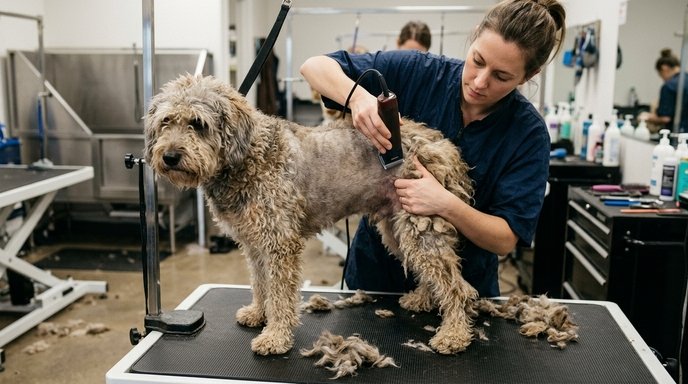
When mats are tight to the skin and widespread, the kindest and safest option is often a full shave-down. Groomers call this a "humane clip." The resulting coat is short, sometimes very short, but the dog is no longer in pain from the constant pulling of mats on the skin.
Some owners are upset by this outcome because they had a specific look in mind. A good groomer will explain the situation before touching the clippers. The dog's comfort is the priority, and a coat grows back. Skin damage from aggressive mat removal does not heal as easily.
At Foothills Dog Grooming, we always talk through the options before starting on a matted coat. If a shave-down is the right choice, we explain why and what to expect before proceeding, not after.
Preventing Mats From Coming Back
The coat grows back from a shave-down, but without a maintenance plan it mats again. The two most effective things owners can do:
- Brush with a metal comb, not just a slicker. A slicker brush makes the top of the coat look smooth without necessarily reaching the undercoat where mats form. The metal comb is the only reliable test of whether the coat is actually clear down to the skin.
- Keep a consistent grooming schedule. A dog groomed every 6 to 8 weeks never accumulates the growth that leads to serious matting. An appointment before the coat needs it is always easier and less expensive than one after.
Dealing With a Matted Coat?
Call before you book. Describing the coat over the phone helps us give you a realistic estimate of what the appointment will involve.
Call (865) 324-6678