

What Is a De-Shedding Treatment for Dogs?
A de-shedding treatment removes loose undercoat before it ends up on your floors and furniture. Here is what the process actually involves and which dogs benefit most.
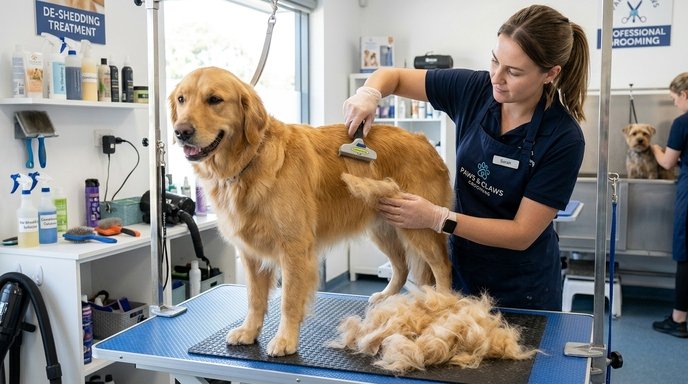
What a De-Shedding Treatment Actually Does
A de-shedding treatment is a professional grooming service designed to remove loose undercoat before it ends up on your furniture, floors, and clothes. It goes significantly further than a standard bath and brush. The goal is to pull out as much dead undercoat as possible while the coat is clean, conditioned, and fully blown dry, so that what remains on the dog is live, healthy coat.
The treatment works because of the sequence, not just the tools. Bathing with a de-shedding shampoo loosens the undercoat. High-velocity drying blows a significant portion of it out before brushing begins. Then a dematting rake or undercoat brush pulls out what the dryer left behind. Done properly, a single de-shedding appointment can remove more loose coat than weeks of home brushing.
Which Dogs Benefit from It
De-shedding treatments are designed for dogs with a double coat, meaning a soft, dense undercoat beneath a coarser outer coat. These breeds shed the most and hold the most dead hair:
Breeds That Benefit Most
- Siberian Husky, Alaskan MalamuteHeavy shedders year-round
- German Shepherd, Belgian MalinoisContinuous heavy shed
- Golden Retriever, Labrador RetrieverSeasonal coat blows
- Australian Shepherd, Border CollieDense double coat
- Bernese Mountain Dog, Great PyreneesXL undercoat volume
- Corgi, Shiba Inu, AkitaCompact but high shed
Single-coated breeds like Poodles, Yorkies, and Maltese do not have an undercoat and do not benefit from de-shedding treatments. They shed minimally and need a different set of grooming services entirely.
What the Process Looks Like
Step 1 — De-Shedding Shampoo and Conditioner
The bath uses a shampoo formulated to loosen the undercoat rather than simply clean the surface. A conditioning treatment follows, which softens the coat and makes the subsequent brushing more effective and more comfortable for the dog.
Step 2 — High-Velocity Blow Dry
This is the step that separates a professional de-shedding treatment from anything achievable at home. A high-velocity dryer forces air through the coat at speed, physically blowing loose undercoat out. The volume of hair that comes out during this step on a heavily shedding Husky or Shepherd can be dramatic. This step also lifts the coat, making the subsequent brush-out more effective.
Step 3 — Brush Out
Once the coat is dry, a groomer works through it systematically with an undercoat rake or dematting tool, pulling out the remaining loose coat. For breeds with heavy seasonal sheds, this step can take 30 to 60 minutes on its own.
A proper de-shedding treatment requires the coat to be completely dry before brushing begins. Brushing a damp coat drives loose hair back into the undercoat rather than removing it. This is one reason professional results consistently outperform home de-shedding attempts.
How Often to Get a De-Shedding Treatment
Most double-coated dogs benefit from a de-shedding treatment every 6 to 8 weeks as part of a regular grooming schedule. During spring and fall coat blows, when seasonal shedding peaks, adding an extra de-shedding appointment reduces the volume of hair dramatically. Some owners of heavy shedders schedule de-shedding appointments every 4 weeks during peak seasons.
Can You Do It at Home?
Home brushing with an undercoat rake or slicker brush removes some loose coat, and doing it consistently between professional appointments reduces the buildup. What home brushing cannot replicate is the high-velocity drying step, which removes a significant portion of the dead undercoat before any brushing begins. The professional result on a heavily shedding dog is meaningfully different from even a thorough home brush-out.
What It Is Not
A de-shedding treatment is not the same as shaving. Shaving a double-coated breed removes both the outer coat and the undercoat and is generally not recommended for breeds whose coats serve a temperature-regulating function. A de-shedding treatment removes only the loose, dead undercoat while leaving the live coat intact. The dog goes home looking tidier and shedding significantly less, but the coat structure is unchanged.
For dogs like Huskies, Shepherds, and Goldens who need to manage their body temperature in both heat and cold, keeping the coat intact through de-shedding rather than shaving is the right approach. At Foothills mobile dog grooming, we offer de-shedding as part of the service that comes to your location if the drive is the hard part.
Dealing With Seasonal Shedding?
Call to ask about de-shedding appointments and whether the timing is right for your dog's coat cycle.
Call (865) 324-6678