

How Often Should You Groom Your Dog, by Breed
Breed gives you a useful starting point, but coat type, lifestyle, and home brushing habits matter just as much. Here is a practical guide by coat category.
Why Breed Is a Starting Point, Not the Whole Answer
Breed gives you a useful baseline for grooming frequency, but two dogs of the same breed can have very different coats depending on genetics, age, diet, and how much time they spend outdoors. A Golden Retriever who swims twice a week needs more frequent attention than one who mostly stays inside. A Poodle mix whose owner brushes daily can go longer between professional appointments than one who rarely gets brushed at home. Use breed as a starting point and adjust from there.
The most reliable guide is not a calendar, it is the metal comb test. If a metal comb moves from the skin to the tip of the coat without catching, the coat is in good shape. When it starts to catch regularly, an appointment is due regardless of how long it has been.
Short-Coated Breeds
Breeds like Beagles, Boxers, Weimaraners, Vizslas, and most hound mixes have coats that require minimal professional grooming. They do shed, sometimes heavily, but their coats do not mat and rarely need trimming.
Short-Coated Breed Grooming Frequency
- Professional groom or bathEvery 8–12 weeks
- Home brushingWeekly with a rubber brush
- Nail trimEvery 4–6 weeks
- Ear cleaningMonthly or as needed
Double-Coated Breeds
German Shepherds, Golden Retrievers, Labrador Retrievers, Huskies, Australian Shepherds, and Bernese Mountain Dogs all carry dense double coats that shed heavily, especially during seasonal coat blows in spring and fall. These breeds benefit from professional grooming more for de-shedding than for trimming.
Double-Coated Breed Grooming Frequency
- Professional bath and de-shedEvery 6–8 weeks
- Extra de-shedding session (spring and fall)Seasonal
- Home brushing2–3 times per week minimum
- Nail trimEvery 4–6 weeks
A note on shaving double coats: routine shaving of breeds like Huskies or German Shepherds is not recommended. The double coat serves as natural insulation in both heat and cold. A de-shedding treatment removes loose undercoat without disrupting the coat's structure. Regular shaving can damage the coat's ability to regrow properly, a condition groomers call coat funk syndrome.
Continuously Growing Coats (Poodles, Doodles, Schnauzers)
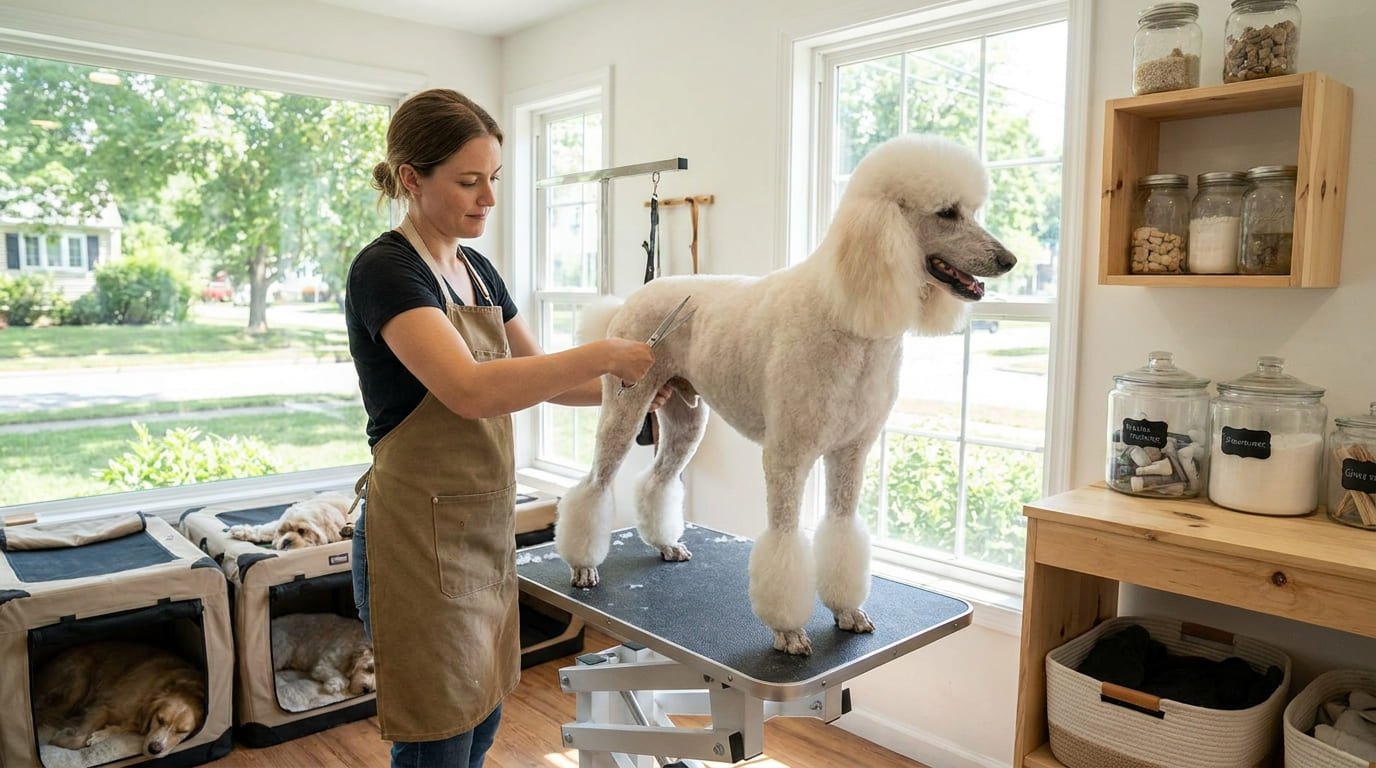
Poodles, all Doodle crosses, Bichons, Schnauzers, Shih Tzus, Maltese, and Yorkies have coats that grow continuously rather than shedding. These coats mat easily below the surface and require the most frequent professional grooming of any coat type.
Continuously Growing Coat Frequency
- Professional full groomEvery 4–8 weeks
- Home brushing (metal comb to skin)Every 2–3 days
- Nail trimEvery 4–6 weeks
- Ear cleaning and pluckingEvery groom
The 4-week end of the range applies to dogs kept in longer styles where mat formation is faster. Dogs kept in a short, practical cut can often stretch to 8 weeks. The longer the coat, the more often it needs professional attention.
Wire-Coated Breeds
Airedale Terriers, Wire Fox Terriers, and similar breeds have a harsh, bristly coat that requires a specific technique called hand-stripping for proper maintenance. Hand-stripping removes dead coat by the root rather than cutting it, which preserves the coat's texture. Clipping a wire coat rather than stripping it gradually softens the texture over time.
Not all groomers offer hand-stripping, and it is more time-intensive than standard clipper work. If you have a wire-coated breed and want to maintain the correct texture, ask specifically about hand-stripping when you call.
Puppy Coats
Puppies should have their first professional groom between 12 and 16 weeks, after the initial round of vaccinations is complete. The goal at the first appointment is not a finished haircut but exposure to the table, the tools, and the process in a calm, low-pressure setting. A puppy who has positive early experiences with grooming is almost always easier to groom as an adult. At Foothills Dog Grooming, first puppy grooms are kept short and treat-heavy for exactly this reason.
Senior Dogs
Older dogs often need more frequent grooming, not less. Joints that ache make it harder for them to clean themselves, and coats that were easy to maintain at 3 years can become harder to manage at 10. Shorter, practical cuts that require less at-home maintenance work well for most senior dogs. Mention your dog's age and any mobility concerns when you book so the appointment can be paced appropriately.
Not Sure How Often Your Dog Needs to Come In?
Call and describe the breed and coat. We can give you a realistic schedule based on what the coat actually needs.
Call (865) 324-6678