
Do Dog Groomers Need a License in Tennessee?
Tennessee does not require dog groomers to hold a state license. Here is what that means for you as an owner, and what to look for instead.
The Short Answer: No State License Is Required
Tennessee does not require dog groomers to hold a state-issued license to operate. Anyone can legally offer professional grooming services in the state without completing a formal certification program or passing a state exam. This is not unusual — the majority of U.S. states do not regulate dog grooming at the state level.
That does not mean all groomers are equally qualified. It means the burden is on the owner to ask the right questions, since there is no licensing board doing that screening for you.
What Tennessee Does Require
While grooming itself is not licensed, businesses that board animals overnight or operate as kennels may be subject to county or municipal regulations in Tennessee. Grooming-only operations that do not board dogs typically fall outside those requirements as well.
Some counties and cities have their own local business licensing requirements that apply broadly, but these are business operation licenses, not grooming-specific credentials. If you are looking at a grooming business in Maryville or Blount County, the relevant question is whether they hold a valid local business license, not a grooming license.
Tennessee state law does regulate animal cruelty and the handling of animals in care. A groomer who causes harm through negligence or intentional mistreatment can face legal consequences under those statutes, even without a licensing framework specifically for groomers.
What Certification Does Exist (And What It Means)
Because the state does not license groomers, the industry has developed its own voluntary certification programs. The two most recognized are:
Voluntary Grooming Certifications
- National Dog Groomers Association of America (NDGAA)Industry certification
- International Professional Groomers (IPG)Industry certification
- Certified Master Groomer (CMG) — NDGAA highest levelAdvanced credential
- Grooming school completion certificateVaries by school
- Fear Free Grooming certificationHandling focused
These credentials are earned through a combination of written exams, practical skills testing, and continuing education. They are meaningful signals of commitment and training, but they are not required by law. A groomer can operate legally in Tennessee with zero formal training, and a groomer with a CMG credential has met a rigorous voluntary standard. The credentials themselves tell you a great deal about how seriously someone takes the work.
What Actually Matters More Than a License
In the absence of mandatory licensing, the things worth paying attention to when choosing a groomer are the ones that licensing would theoretically screen for.
Handling Approach
How a groomer handles a nervous, reactive, or first-time dog is one of the most important things to understand before handing yours over. Ask directly: what do they do when a dog becomes anxious or difficult? A groomer who relies on restraint and rushing through it is using a fundamentally different approach than one who pauses, reassesses, and adjusts the pace. Neither is necessarily illegal, but one is better for most dogs.
Transparency About What Happened
A groomer worth using will tell you at pickup if something did not go as planned, if the coat required a shorter cut than discussed, if the dog had a hard time, or if they noticed something on the skin worth having a vet look at. A groomer who hands your dog back without comment when things went sideways is telling you something important about how they operate.
Clean, Organized Facility
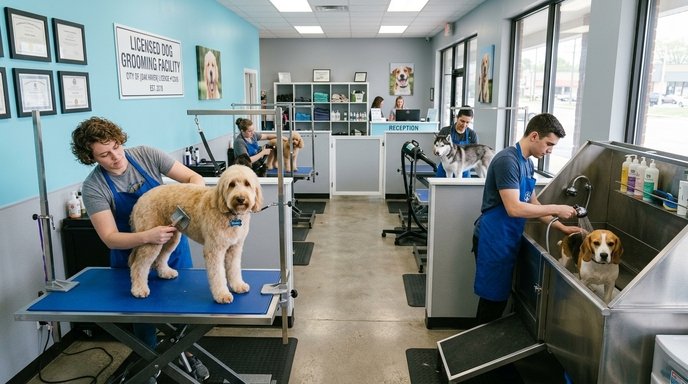
Sanitation standards for grooming facilities are not tightly regulated in Tennessee, which means the cleanliness of a salon reflects the owner's personal standards more than any external requirement. Visit before booking if you can. A facility that is visibly dirty, smells strongly of ammonia, or has equipment that looks worn and poorly maintained is showing you something no license requirement would catch.
References and Reviews
Because licensing does not create a public record of a groomer's performance, actual client reviews and word of mouth carry more weight in this industry than in licensed fields. Reviews that mention how the dog behaved after the appointment, whether the groomer communicated well, and whether results matched what was discussed are more useful than star ratings alone.
The most reliable signal is usually a dog that comes home calm, clean, and without signs of stress. A dog that is visibly anxious, has unexplained marks, or is consistently worse after visits at a particular salon is giving you direct feedback that no credential or review can override.
Questions About Our Approach?
Call and ask anything before you book. We would rather answer questions upfront than have you unsure about leaving your dog with us.
Call (865) 324-6678